
Qwen3 Explained: Alibaba’s Open-Weight Model Line with Hybrid Thinking
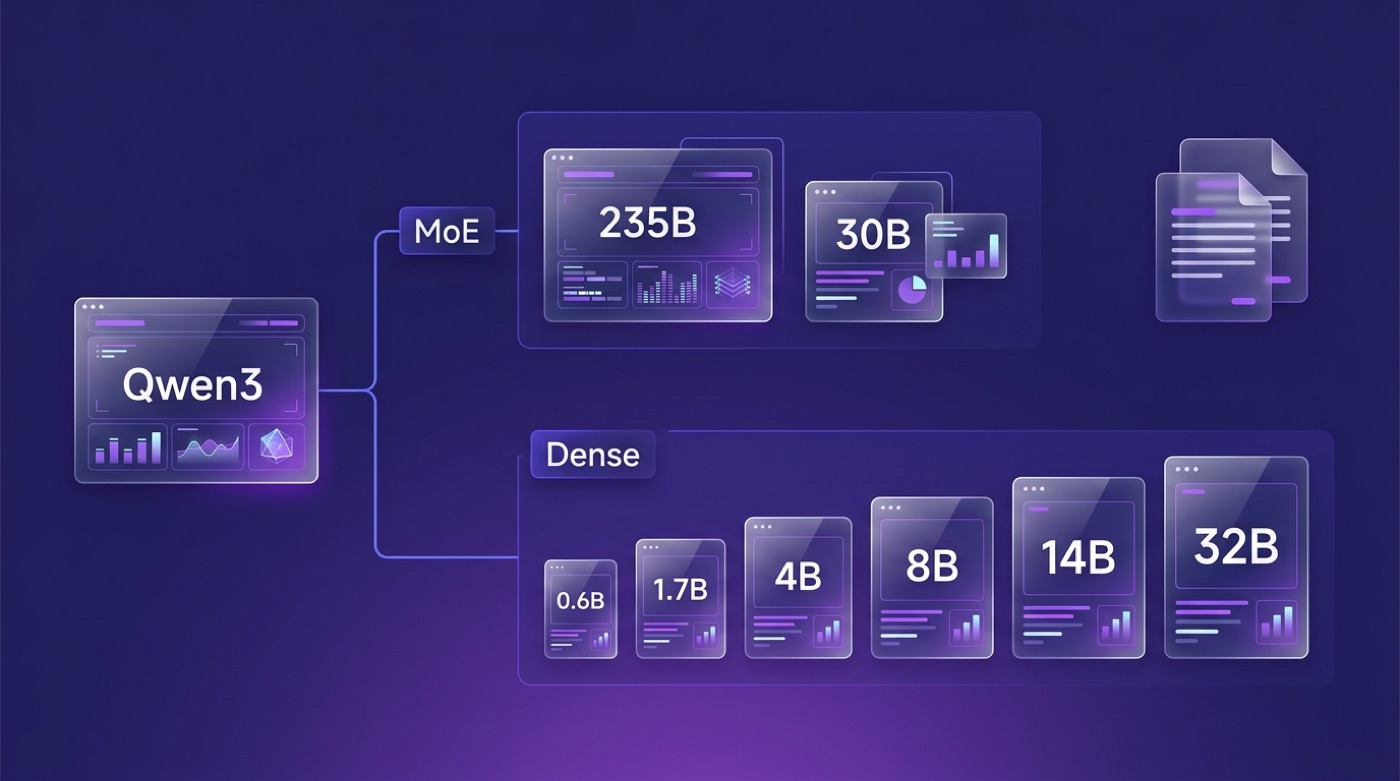
Qwen3 is the third-generation model family from Alibaba’s Qwen Team, released in April 2025, and you can try Qwen chat online to see it firsthand. According to the official Qwen3 blog, the line spans open-weight models under the Apache 2.0 license — from tiny 0.6B-parameter dense models up to a 235B-parameter Mixture-of-Experts flagship — all sharing one “hybrid thinking” design.
What makes the line notable is that a single model can switch between step-by-step “thinking” mode and fast “non-thinking” mode, and the weights are free to download and run. This is an unofficial reference site and is not affiliated with Alibaba or the Qwen team.
What is Qwen3?
Qwen3 sits at the center of a fast-moving open-weight AI landscape, and understanding where it came from helps explain why it drew so much attention on release.
The third generation of Qwen
Qwen3 is the April 2025 successor to Qwen2.5, developed by Alibaba’s Qwen Team. It’s best understood as a family of models rather than a single release — the Qwen3 blog describes eight open-weight variants shipped together, with weights distributed on Hugging Face, GitHub, and ModelScope. Exact release timing (late April 2025) and version specifics are attributed to the official Qwen3 announcement, and any sizes or dates below should be treated as sourced from that post and the accompanying Qwen3 Technical Report rather than fixed specifications.
Why the line matters
Qwen3 was among the first major open-weight families to ship a “hybrid” reasoning approach inside a single model rather than as separate reasoning and non-reasoning releases. Per the Qwen3 blog and technical report, the flagship is positioned as competitive with several frontier models, including:
- DeepSeek-R1
- OpenAI’s o1
- OpenAI’s o3-mini
- Grok-3
- Gemini-2.5-Pro
This is a comparison the Qwen Team makes itself, so it should be read as a vendor claim rather than an independent benchmark.
The Qwen3 model lineup: MoE flagship and dense sizes
The Qwen3 release bundles eight open-weight models built on two different architectures: Mixture-of-Experts (MoE) and dense.
The two MoE models
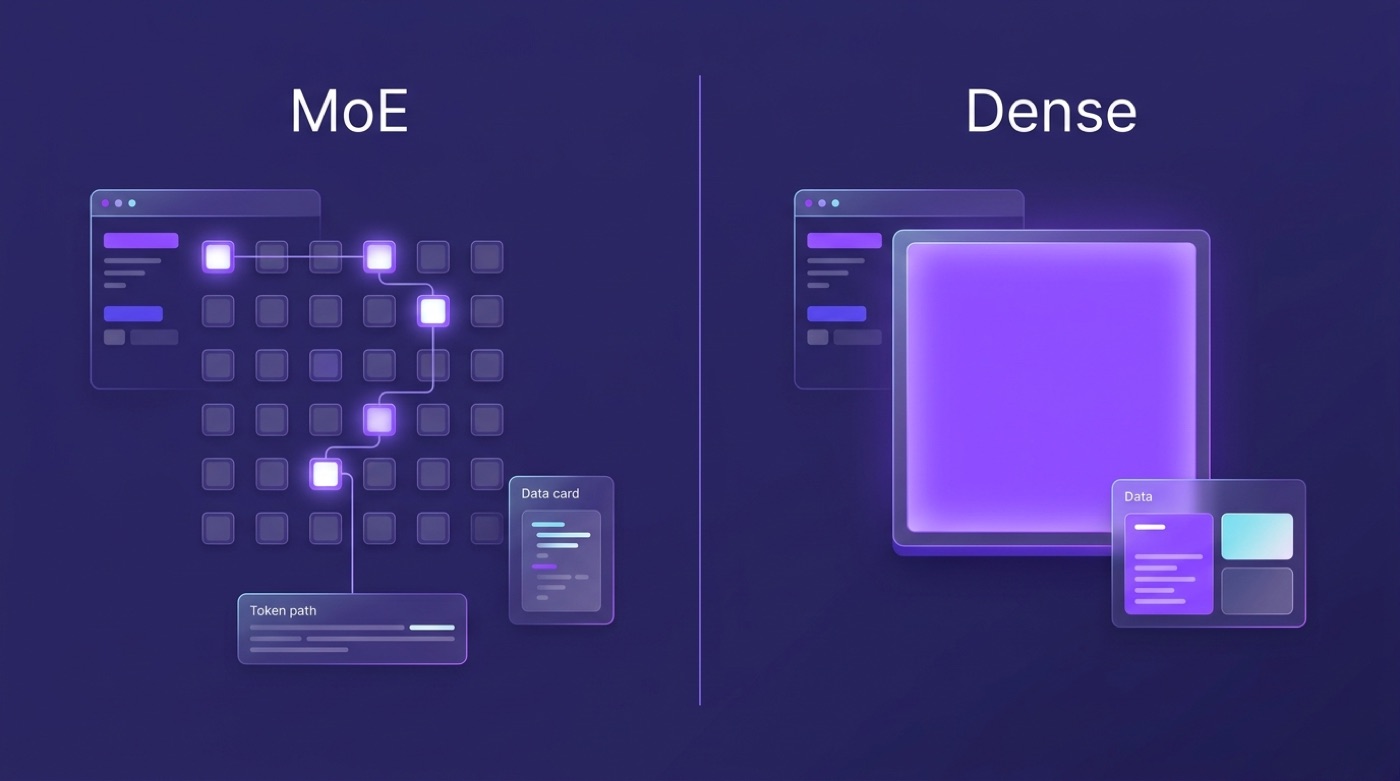
Qwen3-235B-A22B is the flagship: 235 billion total parameters, with roughly 22 billion activated per token. Qwen3-30B-A3B is the smaller MoE option, with 30 billion total parameters and about 3 billion active. The “A22B” and “A3B” suffixes refer to activated parameters — in an MoE architecture, only a subset of the model’s experts fire for any given token, which keeps compute cost closer to the active-parameter count even though the full model is much larger. Per the Qwen3 blog, both MoE models route each token through 8 of 128 available experts.
The six dense models
The other six releases are dense models, built on the same underlying architecture family but without expert routing:
- Qwen3-0.6B
- Qwen3-1.7B
- Qwen3-4B
- Qwen3-8B
- Qwen3-14B
- Qwen3-32B
Having a range this wide lets the line cover everything from edge and mobile deployment (the 0.6B and 1.7B models) up to server-grade workloads. Qwen3-32B is described in the technical report as the largest dense model in the open-weight release.
| Model | Type | Total params | Active params | Notes |
|---|---|---|---|---|
| Qwen3-235B-A22B | MoE | 235B | ~22B | Flagship |
| Qwen3-30B-A3B | MoE | 30B | ~3B | Smaller MoE |
| Qwen3-32B | Dense | 32B | 32B | Largest dense model |
| Qwen3-14B | Dense | 14B | 14B | — |
| Qwen3-8B | Dense | 8B | 8B | Up to 128K context |
| Qwen3-4B | Dense | 4B | 4B | 32K context |
| Qwen3-1.7B | Dense | 1.7B | 1.7B | 32K context |
| Qwen3-0.6B | Dense | 0.6B | 0.6B | Smallest, edge use |
Hybrid thinking: two modes in one model
Hybrid thinking is the feature the Qwen Team leans on hardest in its own framing of the release, and it’s what most distinguishes Qwen3 from the Qwen2.5 line.
Thinking mode vs non-thinking mode
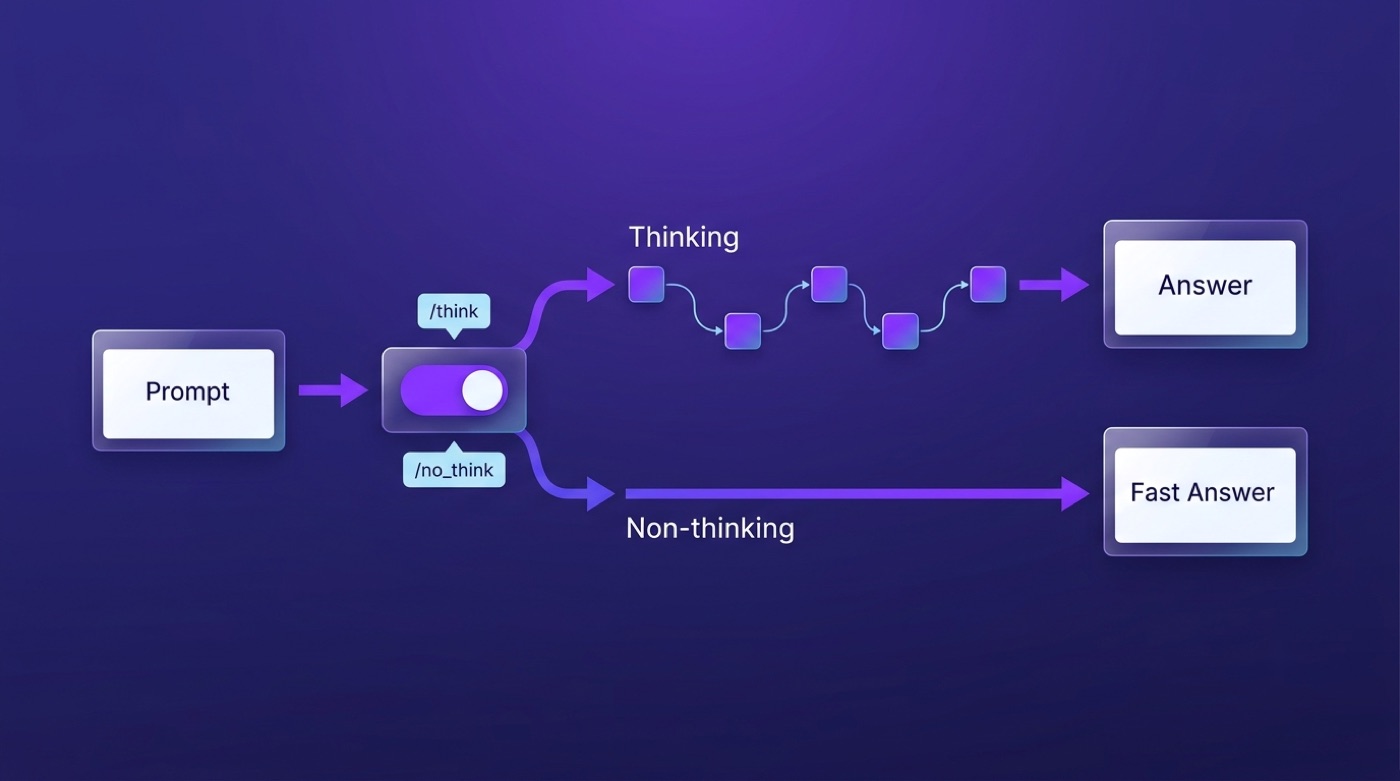
In thinking mode, Qwen3 works through a problem step by step before answering — useful for hard math, coding, and multi-step logic. In non-thinking mode, the same model responds quickly and directly, skipping the visible reasoning trace. Both modes live inside one model rather than requiring two separate downloads, and per the Qwen3 blog and technical report, users can toggle between them per turn using /think and /no_think tags in the chat.
The thinking budget
Alongside the mode switch, Qwen3 supports a “thinking budget” — a cap on how many tokens the model spends reasoning before it has to answer. Per the blog and technical report, this lets you trade latency and cost against reasoning depth, rather than treating every query as either fully verbose or fully terse.
This flexibility allows users to control how much “thinking” the model performs based on the task at hand.
— Qwen3 blog
Open-weight and Apache 2.0: free to download and run
Licensing is one of the clearest facts about the release, and it’s what makes Qwen3 usable well beyond Alibaba’s own infrastructure.
All eight open-weight models are released under Apache 2.0. That means anyone can download the weights, fine-tune them, and deploy them commercially without a per-call licensing fee — a sharp contrast to closed, API-gated models where every request runs through the vendor’s servers. Qwen3-Max, covered further below, is the one exception in the line: it stays proprietary and API-only.
The models are distributed through Hugging Face, ModelScope, and GitHub. The Qwen organization on Hugging Face hosts the model cards and weight files for each size, and they’re commonly run through inference frameworks like vLLM, SGLang, Ollama, or llama.cpp once downloaded.
Running locally isn’t the only option. For a quicker path, you can just use Qwen AI chat free in a browser without setting up any local infrastructure.
Getting a Qwen3 model running locally generally follows the same handful of steps regardless of which size you pick:
- Pick a model size based on your hardware — 0.6B–4B for consumer GPUs or edge devices, 8B–32B dense for stronger single-GPU or multi-GPU setups, or one of the MoE models for server-class deployments.
- Visit the model’s page on the Qwen Hugging Face org and download the weights, or pull them through ModelScope.
- Choose an inference runtime — vLLM and SGLang for throughput-focused serving, Ollama or llama.cpp for simpler local setups.
- Load the model and confirm it responds in non-thinking mode first, since it’s faster to sanity-check.
- Test thinking mode with a multi-step reasoning or coding prompt using the
/thinktag. - Set a thinking budget if you need to control response latency or token cost.
- Integrate the model into your application or agent framework, using Model Context Protocol (MCP) support where relevant for tool use.
Multilingual reach and context length
Two of the more concrete, measurable upgrades in Qwen3 are language coverage and how much text a model can hold in context at once.
119 languages and dialects
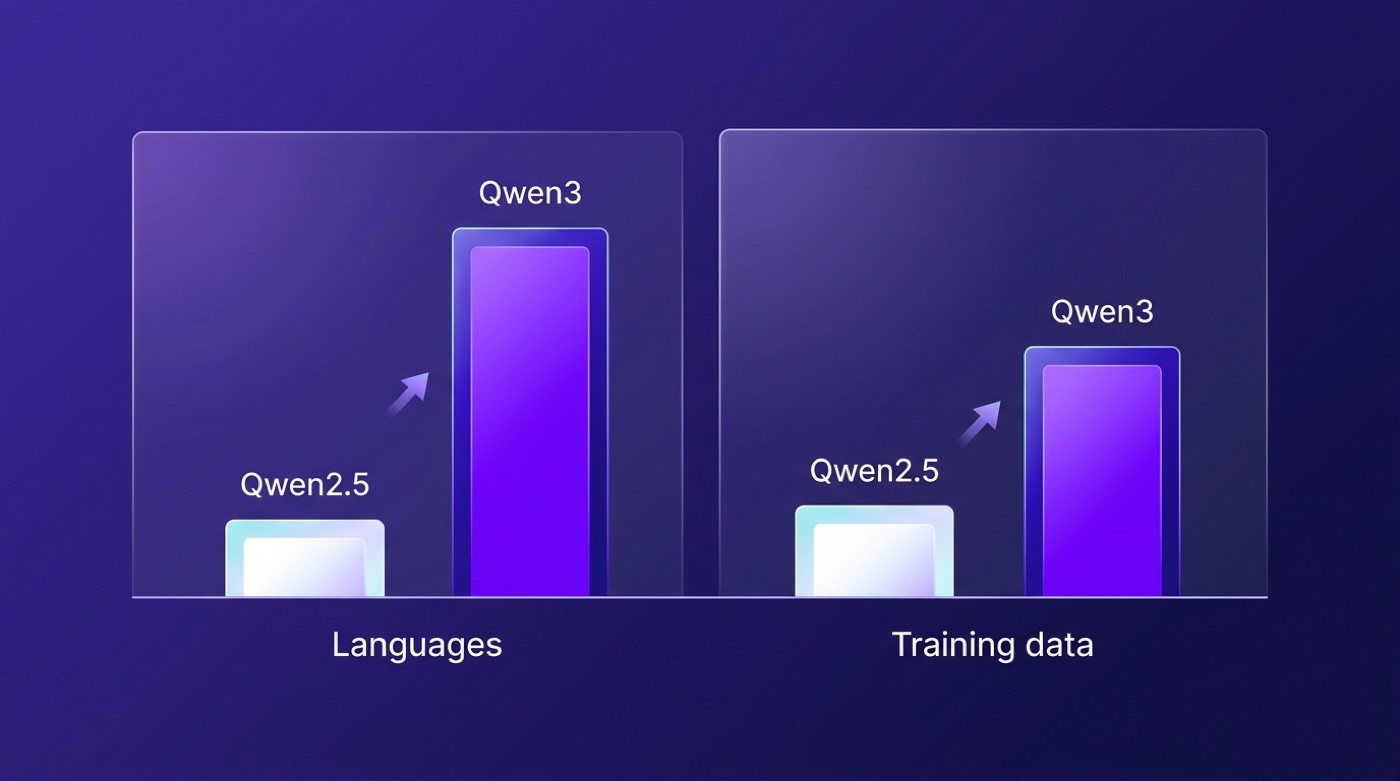
According to the Qwen3 blog and the accompanying arXiv technical report, the line expanded language and dialect coverage from 29 in Qwen2.5 to 119 in Qwen3. That breadth matters most for use cases such as:
- Multilingual chat and customer support across markets
- Translation-adjacent tasks
- Agentic workflows that need to operate in a user’s native language rather than defaulting to English
That’s roughly a fourfold jump in coverage compared with Qwen2.5.
How much context fits
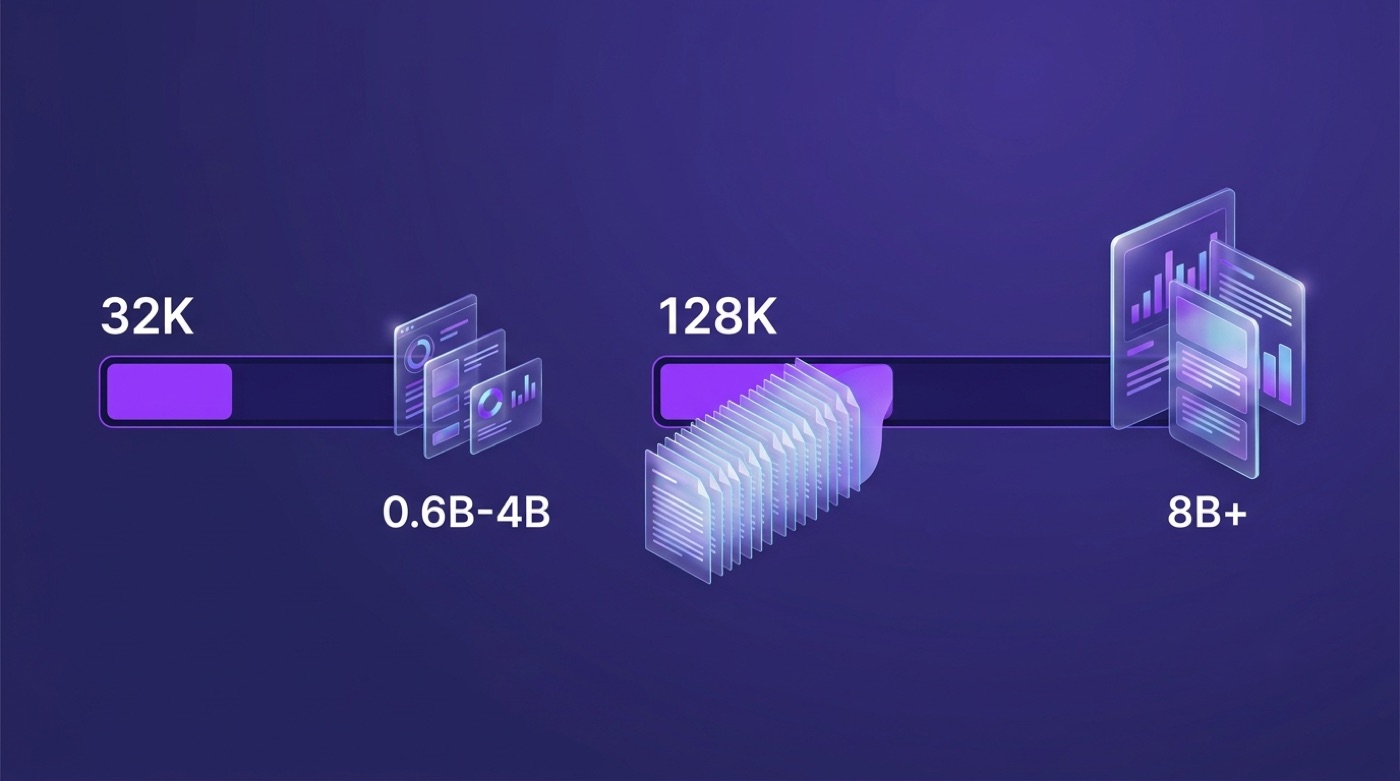
Context length varies by model size. Per the Qwen3 blog, the smaller dense models — 0.6B, 1.7B, and 4B — support up to 32K tokens of context, while 8B and larger models support up to 128K tokens. In practical terms, context length determines how much text (a long document, a large codebase, an extended conversation history) the model can consider at once without losing track of earlier content.
What’s new vs Qwen2.5
Qwen3’s biggest changes over its predecessor aren’t cosmetic — they show up in training scale, language coverage, and a genuinely new capability.
Bigger training, more languages
Qwen3 was pretrained on roughly 36 trillion tokens, about double Qwen2.5’s roughly 18 trillion, per the Qwen3 blog and technical report. Combined with the jump from 29 to 119 supported languages, this is the clearest quantitative gap between the two generations.
New capabilities
Hybrid thinking itself is new to the family — Qwen2.5 didn’t ship a unified thinking/non-thinking toggle in one model. The Qwen3 blog and technical report also describe stronger reasoning, coding, and agentic performance, along with support for the Model Context Protocol (MCP) for tool integration.
| Aspect | Qwen2.5 | Qwen3 |
|---|---|---|
| Languages | 29 | 119 |
| Pretraining tokens | ~18 trillion | ~36 trillion |
| Thinking mode | Not unified in one model | Hybrid thinking + non-thinking, toggled per turn |
| Top open model size | Smaller flagship | 235B MoE (Qwen3-235B-A22B) |
| License | Open-weight releases | Apache 2.0 (open-weight releases) |
Qwen3-Coder and Qwen3-Max: extending the line
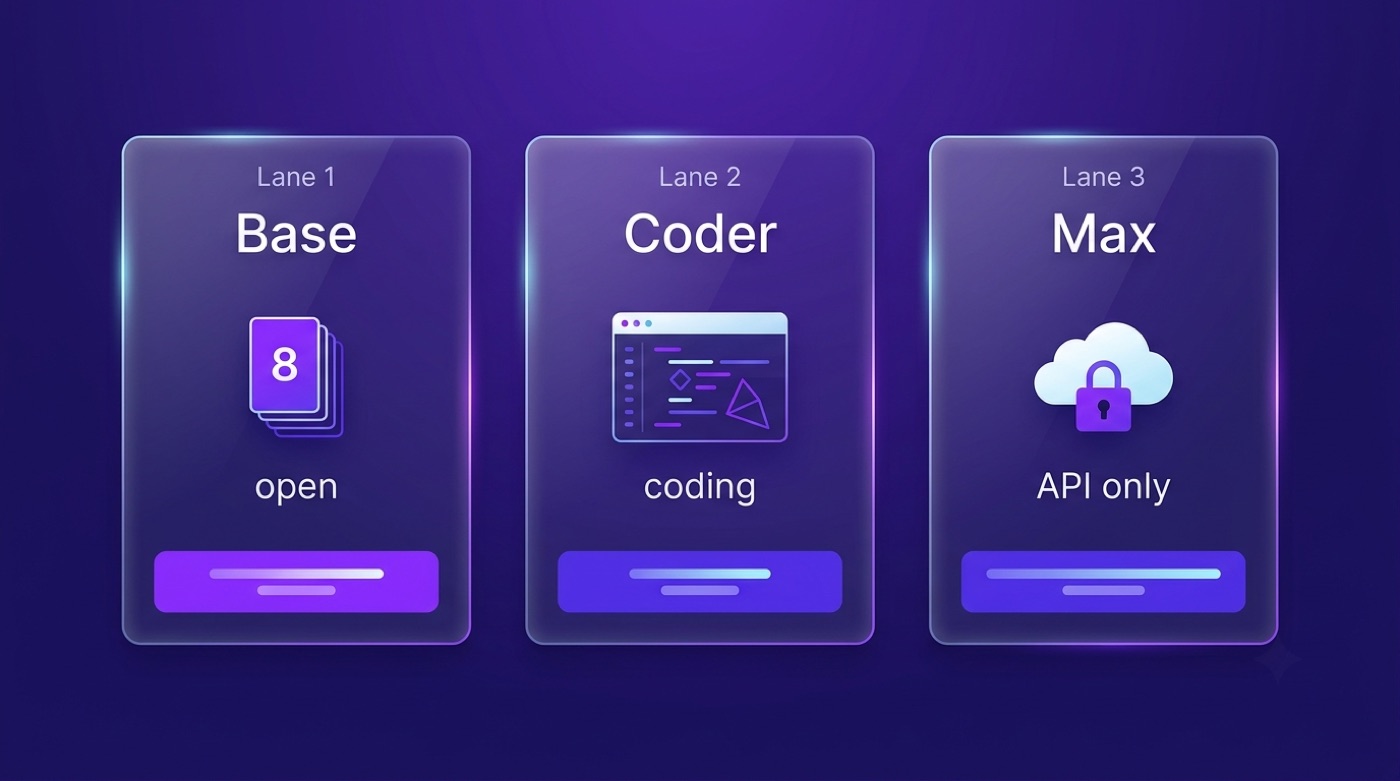
Beyond the eight core open-weight models, the Qwen3 line extends in two directions — one coding-specialized and open, the other proprietary.
Qwen3-Coder adds coding and agentic-coding specialization. Listed on the Qwen Hugging Face org as Qwen3-Coder-480B-A35B-Instruct, it’s a large MoE variant built for programming tasks and coding agents. Exact specs should be treated as hedged pending fuller documentation, since it’s described mainly through the Hugging Face repository rather than the original launch blog.
Qwen3-Max is the closed counterpart to the open lineup. Per Wikipedia’s entry on Qwen, it’s offered as a proprietary top-tier model through Alibaba Cloud’s API rather than as downloadable weights — worth flagging explicitly, since it isn’t detailed in the original open-weight Qwen3 blog post the way the eight Apache 2.0 models are.
What each adds to the line:
- Qwen3-Coder — coding-focused MoE model for programming and agentic-coding workflows, published on Hugging Face.
- Qwen3-Max — proprietary flagship, accessed via API rather than downloaded weights.
- The eight base models — cover general-purpose chat, reasoning, and multilingual use across the open-weight Apache 2.0 releases.
If you’d rather skip the setup entirely, the fastest way to feel out what Qwen3 can do is still Qwen chat in a browser, with no downloads or API keys involved.