
Qwen Models Explained: The Complete Family Guide (Qwen2.5, Qwen3, Coder, VL, QwQ & More)
“Qwen models” are the family of large language models built by Alibaba Cloud, spanning open-weight releases you can download and proprietary flagships you reach only through an API. You can try Qwen Chat free to test most of them in one place, and the full, current line-up is documented on Qwen’s official model cards.
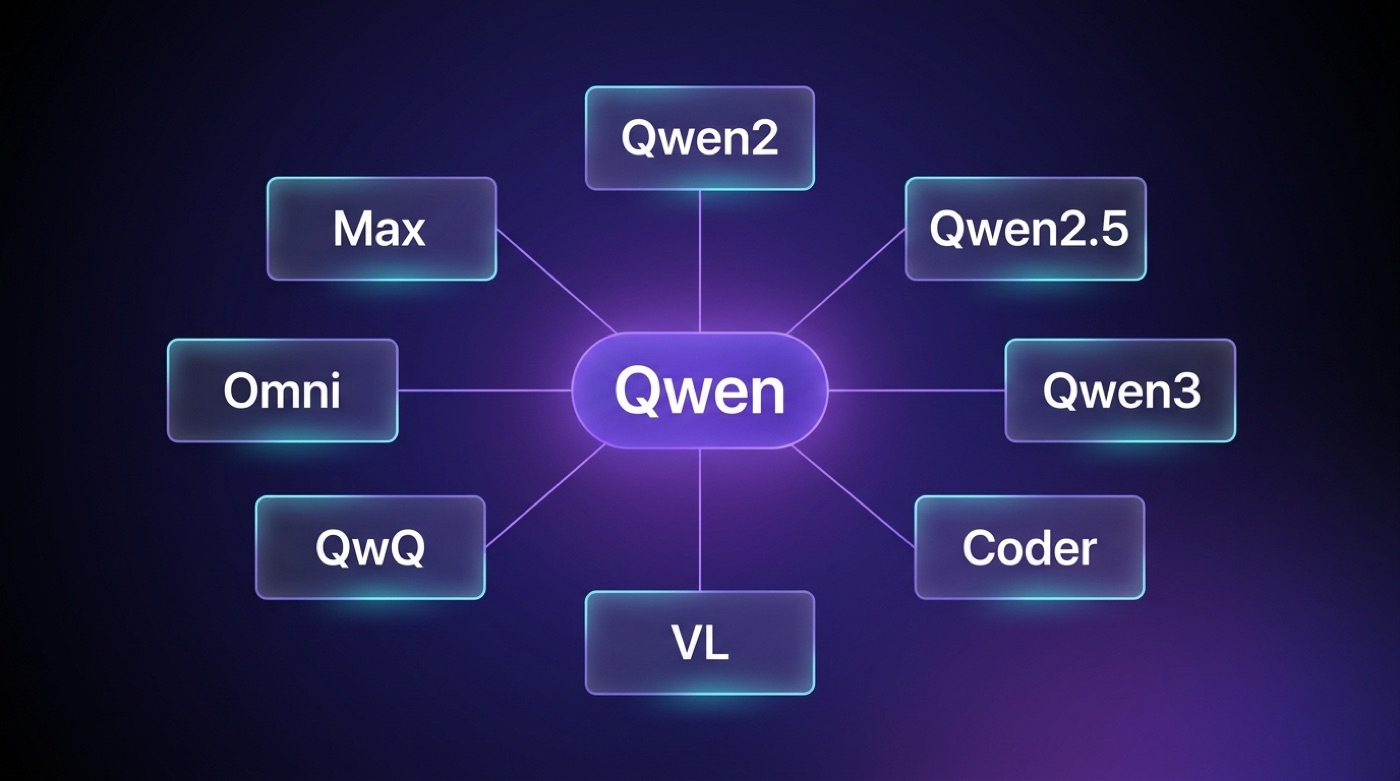
The family splits into general-purpose text models (Qwen2.5, Qwen3) plus specialist branches for coding (Coder), vision (VL), reasoning (QwQ) and multimodal input/output (Omni). This article is a plain-English map of only the models that have actually been released — no rumored or unconfirmed names.
Unaffiliated disclaimer: this is an unofficial reference. It is not affiliated with, endorsed by, or operated by Alibaba, Alibaba Cloud, or the Qwen team. Model names are trademarks of their owners.
What “Qwen” actually means and who builds it
Qwen — whose Chinese name is Tongyi Qianwen — is a family of large language models developed by Alibaba Cloud, as documented on Wikipedia. It has become one of the most-downloaded open-weight model families on Hugging Face, spanning general text models, coding specialists, vision-language systems, a dedicated reasoning model, and multimodal models that handle audio and video alongside text. Source code and model cards for the open releases are maintained on QwenLM’s GitHub.
Two release tracks: open-weight vs proprietary
Most Qwen models are open-weight, meaning Alibaba Cloud publishes the actual model weights for anyone to download, mostly under the Apache 2.0 license, hosted on Hugging Face and ModelScope. A handful of flagship models — Qwen2.5-Max and Qwen3-Max — are proprietary and reachable only through Alibaba Cloud’s API; their weights are never released. It’s worth being precise here: “open-weight” is not the same claim as “open source.” Releasing weights lets you download and run a model yourself, but it doesn’t necessarily mean the training data or training code is public too.
- Apache 2.0 — the license covering most Qwen2.5, Qwen3, Coder, VL, QwQ and Omni sizes; free to use, modify and self-host commercially.
- Qwen / Qwen license — used for a few larger sizes (e.g. the Qwen2.5-72B and Qwen2.5-VL-72B tier); check the specific model card before commercial deployment.
- Qwen Research — a research-only license applied to some of the smallest sizes (e.g. the 3B Coder and Omni variants).
- Proprietary / API-only — Qwen2.5-Max and Qwen3-Max; no weights, no self-hosting, access only through Alibaba Cloud’s API.
The Qwen model family at a glance
The table below lists every confirmed Qwen model line, its published sizes, whether the weights are downloadable, and what it’s built for. Exact parameter counts for the Max models are not officially disclosed by Alibaba Cloud, so they’re marked accordingly rather than guessed.
| Model | Type | Sizes | Open-weight? | Best for |
|---|---|---|---|---|
| Qwen2.5 | Dense text | 0.5B–72B (7 sizes) | Yes (mostly Apache 2.0) | General chat, summarization, extraction |
| Qwen3 (dense) | Dense text | 0.6B–32B (6 sizes) | Yes (Apache 2.0) | General chat with hybrid thinking |
| Qwen3 (MoE) | Mixture-of-Experts | 30B-A3B, 235B-A22B | Yes (Apache 2.0) | Flagship open-weight quality at lower compute |
| Qwen2.5-Coder | Dense text | 0.5B–32B (6 sizes) | Yes (mostly Apache 2.0) | Code generation, completion, repair |
| Qwen3-Coder | MoE | 480B-A35B, 30B-A3B Flash | Yes (Apache 2.0) | Agentic, long-horizon coding |
| Qwen2.5-VL | Vision-language | 3B, 7B, 32B, 72B | Yes (mostly Apache 2.0) | Images, documents, video, OCR |
| QwQ-32B | Reasoning | 32B | Yes (Apache 2.0) | Hard math, coding and agentic reasoning |
| Qwen2.5-Omni | Multimodal | 3B, 7B | Yes (mostly Apache 2.0) | Text/image/audio/video in, text + speech out |
| Qwen2.5-Max | Proprietary MoE | Undisclosed | No (API-only) | Proprietary flagship |
| Qwen3-Max | Proprietary | “Over 1T” (unofficial, not confirmed) | No (API-only) | Top-tier proprietary flagship |
Qwen2.5: the general-purpose dense workhorses
Before Qwen3 introduced Mixture-of-Experts models, Qwen2.5 was Alibaba Cloud’s main dense text line — the one still widely used where a straightforward, no-frills model is enough.
What Qwen2.5 covers
Qwen2.5 was released in September 2024 as a dense (non-MoE) text model line, meaning every parameter is active on every request rather than only a subset of “experts.” It ships in seven dense sizes — 0.5B, 1.5B, 3B, 7B, 14B, 32B and 72B — and handles general text work: chat, summarization, extraction, translation and everyday reasoning. Licensing differs slightly by size: the 72B variant ships under the Qwen license, the 3B model under Qwen Research, and the rest under Apache 2.0.
Picking a size
- 0.5B–1.5B — edge and mobile devices, fast responses on limited hardware.
- 3B–7B — laptops or a single consumer GPU, good balance of speed and quality.
- 14B–32B — workstation-class GPUs, noticeably stronger reasoning.
- 72B — server-grade hardware, the strongest Qwen2.5 tier.
Because licenses vary between sizes, check the specific model card on Hugging Face before deploying commercially.
Qwen3: dense + MoE with hybrid thinking
Qwen3 arrived in late April 2025 — Alibaba Cloud’s own blog dates the release April 29, while Wikipedia lists April 28, so treat it as “late April 2025” rather than a single confirmed day. It’s the newer generation and, unlike Qwen2.5, adds Mixture-of-Experts models on top of the dense lineup.
Dense Qwen3 and the two MoE models
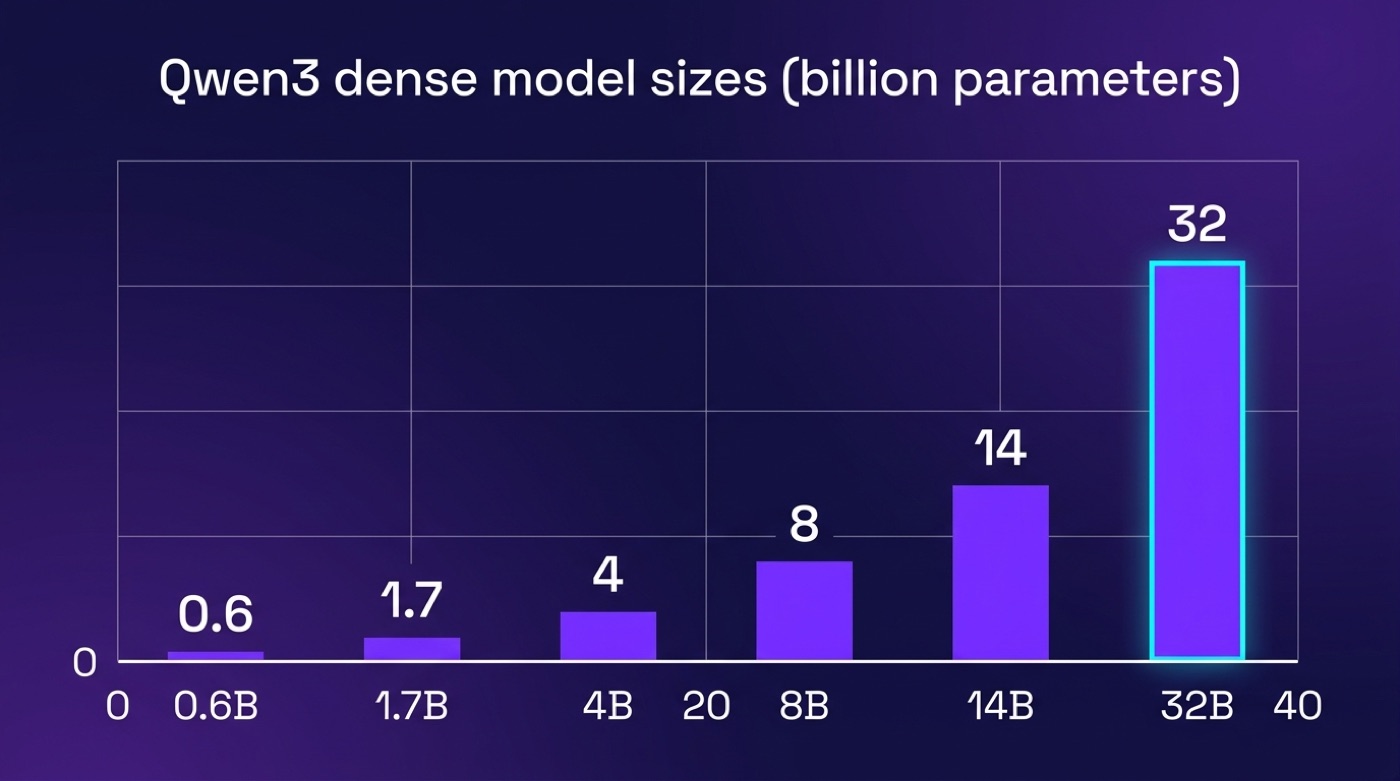
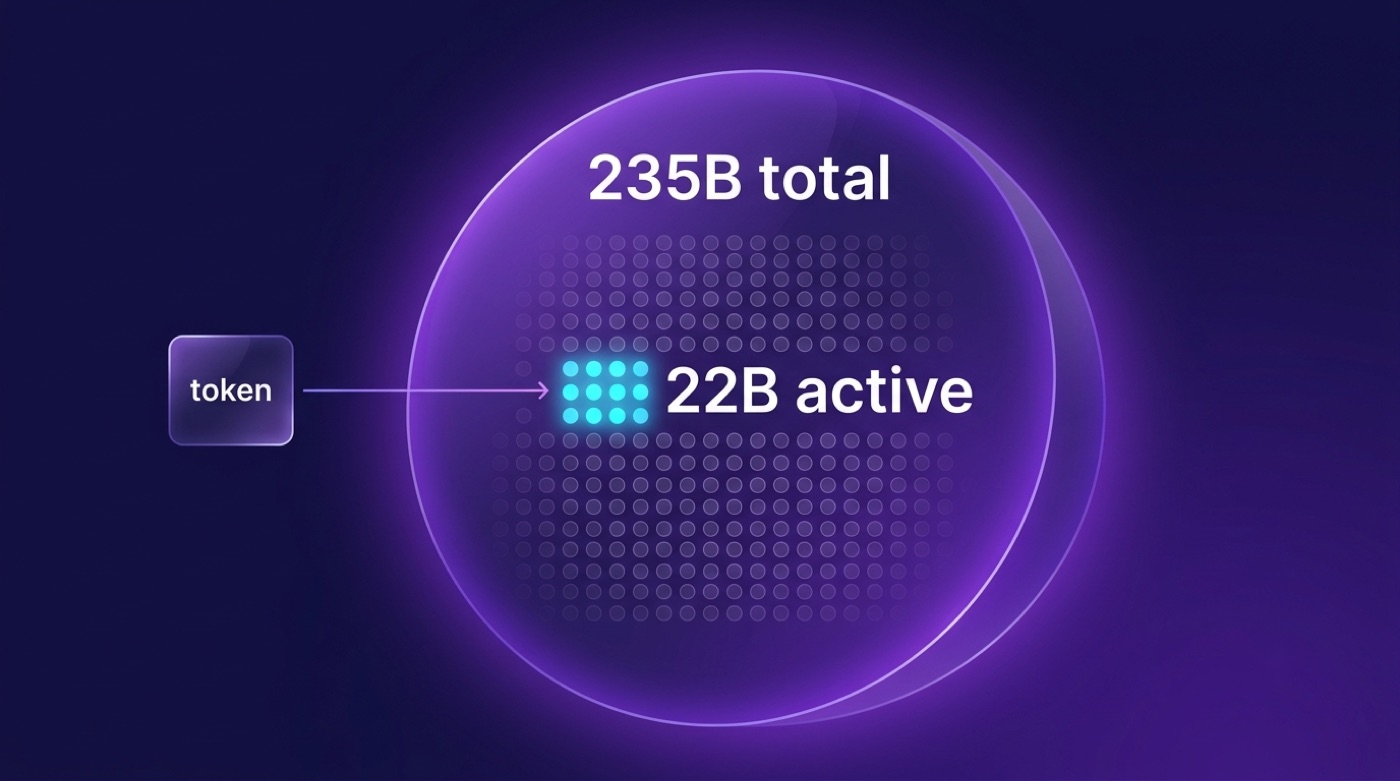
The dense tier spans 0.6B, 1.7B, 4B, 8B, 14B and 32B. Alongside it sit two Mixture-of-Experts models: Qwen3-30B-A3B, with 30B total parameters but only 3B “active” per token, and the flagship Qwen3-235B-A22B, with 235B total parameters and 22B active. A Mixture-of-Experts architecture only fires a subset of its experts for any given token, which is what lets a 235B-parameter model run at a fraction of the compute a same-sized dense model would need. Every Qwen3 model is licensed under Apache 2.0, and the family was trained on roughly 36 trillion tokens across 119 languages and dialects.
Hybrid thinking modes
Qwen3 introduced hybrid thinking: a single model that can switch between a “thinking” mode, which reasons step by step before answering hard problems, and a “non-thinking” mode for near-instant replies on simple ones. The larger models support context windows up to 128K tokens.
Qwen3 supports two thinking modes: thinking mode, where the model takes time to reason step by step before delivering the final answer, and non-thinking mode, where the model provides rapid, near-instant responses.
Qwen3: Think Deeper, Act Faster
Qwen-Coder: models built for code
Qwen also ships a dedicated code-focused branch, split across two generations with very different scale and goals.
Qwen2.5-Coder
Released in November 2024, Qwen2.5-Coder ships in six sizes from 0.5B to 32B, covering code generation, completion, repair and code-focused reasoning across many programming languages. The 32B flagship has been described in the Qwen2.5-Coder announcement as matching GPT-4o-level coding performance. Licensing follows the same pattern as Qwen2.5: mostly Apache 2.0, with the 3B size under Qwen Research.
Qwen3-Coder
Qwen3-Coder, released in July 2025, moves to a much larger, agentic-coding-focused design: Qwen3-Coder-480B-A35B is a Mixture-of-Experts model with 480B total parameters and 35B active, alongside a smaller Qwen3-Coder-30B-A3B “Flash” variant. Both are built for long-horizon coding tasks and tool use — the kind of multi-step work where a model has to plan, write, run and fix code across several turns rather than answer a single prompt.
Qwen-VL: seeing images and documents
Vision is its own branch of the Qwen family, built specifically for tasks a text-only model can’t do — reading a screenshot, a scanned form or a video clip.
From Qwen-VL to Qwen2.5-VL
The original Qwen-VL line launched in 2023 as Alibaba Cloud’s first vision-language model. Its successor, Qwen2.5-VL, released in January 2025, is the current flagship: open-weight in 3B, 7B and 72B sizes, with a 32B variant added on March 24, 2025. Qwen2.5-VL is built to handle:
- Images — general visual understanding and question answering.
- Documents and charts — structured reading of layouts, tables and figures.
- Video — understanding sequences of frames, not just single stills.
- OCR — extracting printed and handwritten text from images.
- Visual grounding — locating and describing specific objects or regions inside an image rather than just describing the picture as a whole.
QwQ: the open reasoning model
Separate from the hybrid thinking added to Qwen3, Qwen also ships a standalone reasoning specialist.
What QwQ-32B is for
QwQ-32B is a 32B-parameter reasoning model scaled with reinforcement learning, released under Apache 2.0 in a blog post dated March 6, 2025. It’s aimed specifically at hard math, coding and agentic reasoning problems, and Alibaba Cloud positions it as competitive with much larger models on those tasks despite its comparatively small size. QwQ is a specialist reasoning model — distinct from the general-purpose Qwen2.5 and Qwen3 lines, even though Qwen3 later added its own hybrid thinking mode.
Qwen2.5-Omni: one model, many senses
Where Qwen2.5-VL only sees, Qwen2.5-Omni is built to see, hear and speak in a single model.
End-to-end multimodal
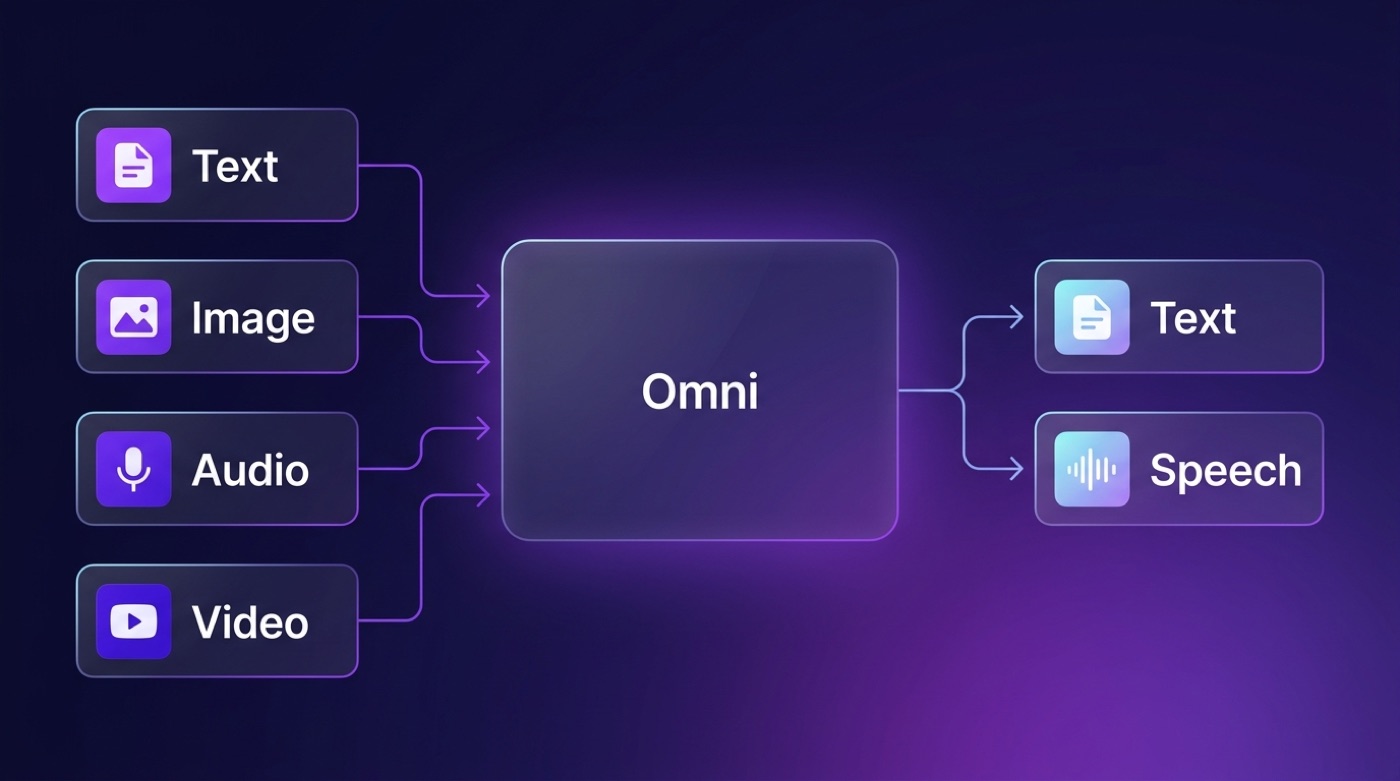
Qwen2.5-Omni, released in March 2025 in 7B and 3B sizes, is Alibaba Cloud’s end-to-end multimodal model. It accepts text, images, audio and video as input, and — unlike most of the other Qwen lines — can output both text and speech, enabling real-time voice conversation rather than text-only replies. The 7B model is licensed Apache 2.0; the 3B size ships under Qwen Research.
The proprietary flagships: Qwen2.5-Max & Qwen3-Max
Not every Qwen model is open-weight. Two flagships sit above the download line, reachable only through Alibaba Cloud’s API.
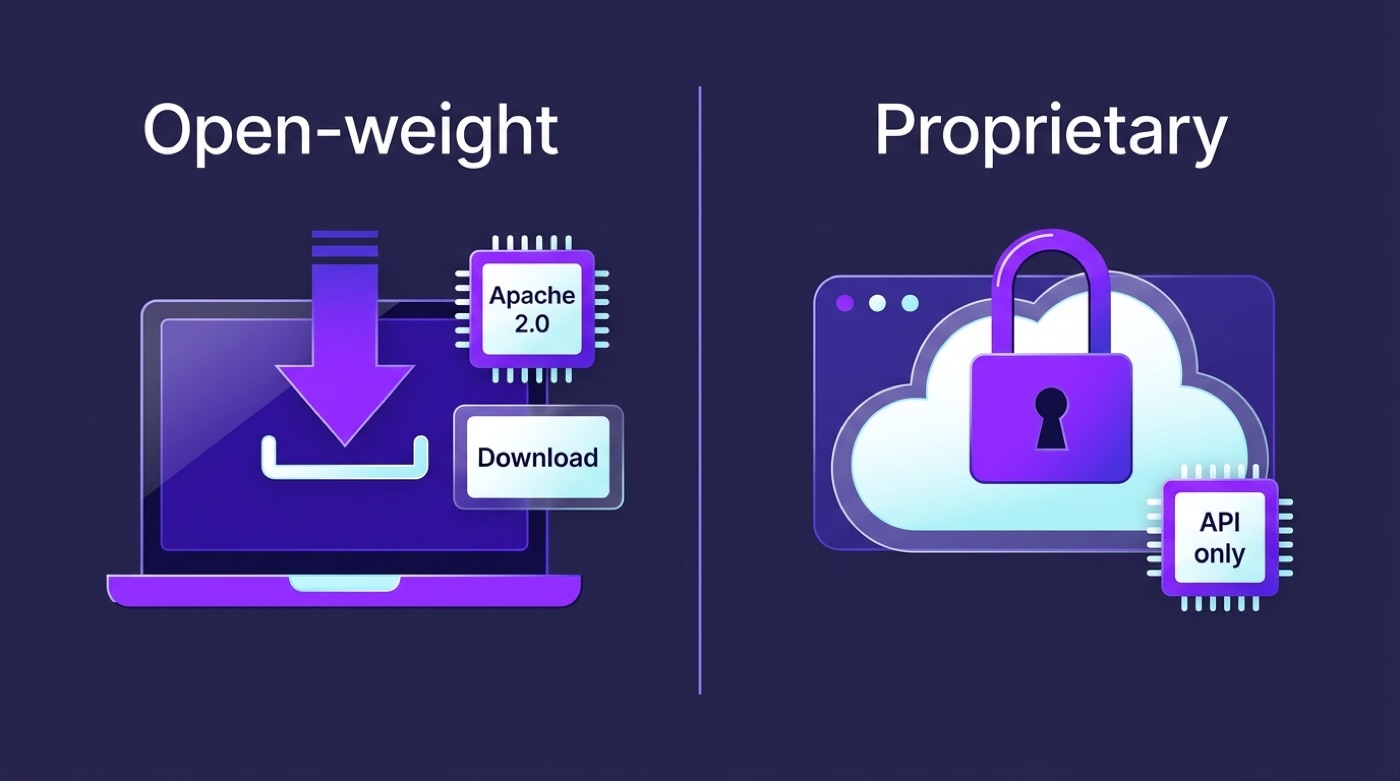
Qwen2.5-Max — proprietary, undisclosed size. Released January 28, 2025, Qwen2.5-Max is a Mixture-of-Experts model whose exact parameter count Alibaba Cloud has not published. You cannot download or self-host it; access is API-only.
Qwen3-Max — the closed top tier. Released in September 2025, Qwen3-Max is reportedly described as having “over 1T parameters” — but that exact figure is not officially confirmed by Alibaba Cloud, so treat it as a hedge rather than a hard spec. It was trained on roughly 36 trillion tokens, the same scale as the open Qwen3 line, but its weights are never released.
Both models represent the closed tier Alibaba Cloud keeps behind an API rather than a download link — the trade-off is convenience and top-end quality against the ability to inspect, fine-tune or self-host the model.
| Model | Released | Training scale | Weights available? |
|---|---|---|---|
| Qwen2.5 | September 2024 | Undisclosed token count | Yes (mostly Apache 2.0) |
| Qwen2.5-Coder | November 2024 | Undisclosed token count | Yes (mostly Apache 2.0) |
| Qwen2.5-VL | January 2025 (32B added March 24, 2025) | Undisclosed token count | Yes (mostly Apache 2.0) |
| QwQ-32B | March 6, 2025 | Undisclosed token count | Yes (Apache 2.0) |
| Qwen2.5-Omni | March 2025 | Undisclosed token count | Yes (mostly Apache 2.0) |
| Qwen2.5-Max | January 28, 2025 | Undisclosed | No (API-only) |
| Qwen3 (dense + MoE) | Late April 2025 | ~36 trillion tokens, 119 languages | Yes (Apache 2.0) |
| Qwen3-Coder | July 2025 | Undisclosed token count | Yes (Apache 2.0) |
| Qwen3-Max | September 2025 | ~36 trillion tokens | No (API-only) |
How to choose a Qwen model (and try one free)
With ten model lines to pick from, the fastest way to decide is by task, not by name.
Quick decision guide
- General chat or writing — Qwen3, with thinking mode turned on for harder tasks.
- Coding help — Qwen2.5-Coder or Qwen3-Coder for agentic, multi-step work.
- Images or documents — Qwen2.5-VL.
- Hard math or logic problems — QwQ-32B.
- Voice or multimodal conversation — Qwen2.5-Omni.
- Maximum quality via API, no self-hosting — Qwen3-Max.
- Running locally — pick a dense Qwen2.5 or Qwen3 size that fits your GPU’s memory.
Try it without installing
You don’t need a GPU or a download to get a feel for these models — you can try Qwen Chat free in the browser before committing to a local install or an API integration. It’s the fastest way to compare how Qwen3’s thinking mode, Qwen2.5-VL’s image handling or QwQ-32B’s reasoning actually behave side by side. For everyday use, most people never need to leave Qwen Chat free at all.