
How to Read Qwen Chat Benchmarks: What MMLU, GPQA, Coding and Math Scores Actually Mean
When people search “qwen chat benchmarks” they usually want one number that says whether Qwen Chat is “good” — but a benchmark is a measuring stick, and the useful skill is knowing which stick measures what. This guide explains the benchmarks the Qwen team reports, from knowledge and coding to math, agentic tool use, and human-preference arenas, and how to read them without being misled by a single headline figure.
We deliberately do not reproduce a big table of exact scores here, because published numbers change with every release and are easy to misquote out of context. Instead you’ll learn what each benchmark tests, where to find the official figures, and the traps that make a headline score mean less than it looks on first read.

This is an unofficial guide, not affiliated with Alibaba or the Qwen team; any benchmark figures are as reported by their original sources and should be verified there before you rely on them. Keep that in mind every time a score gets quoted secondhand, including here.
Benchmarks in one minute: what a score is and isn’t
A benchmark is a fixed set of questions plus a scoring rule — percent correct, an Elo rating, a pass rate. It captures one narrow skill under one specific setup, and nothing more. Two terms show up constantly in Qwen reports and are worth knowing cold: “pass@1” means the model gets one attempt and is graded right or wrong, while “pass@k” gives it k attempts and counts a success if any of them work, which almost always inflates the number. Similarly, “few-shot” means the model sees a handful of solved examples before the test question, while “zero-shot” gives it none — a model can look meaningfully stronger under few-shot prompting even with identical weights.
A benchmark score has a narrow, honest job and a much wider set of jobs it cannot do:
- A score IS a repeatable comparison, as long as the setup (prompt format, shot count, decoding temperature) stays fixed across the models being compared.
- A score IS a proxy for one skill — coding correctness, math reasoning, factual recall — not for the model overall.
- A score is NOT a measure of general intelligence or “how smart” a model feels in conversation.
- A score is NOT a guarantee about your specific use case, which likely differs from the benchmark’s question format.
- A score is NOT automatically free of leakage, meaning the test questions may have appeared in the model’s training data.
Self-reported vs third-party
Model makers, including the Qwen team, publish their own numbers in blog posts and technical reports, run on their own hardware with their own prompt templates. Independent parties — leaderboard maintainers, the authors of EvalPlus, the operators of LMArena — run their own evaluations under conditions the model vendor doesn’t control. Both have a place, but they answer different questions.
The practical rule is simple: treat vendor charts as a starting point, not a verdict, and reach for third-party or arena numbers when the decision actually matters — picking a model for a production coding tool, for example. A self-reported score tells you what the Qwen team measured under the conditions it chose; an independent leaderboard tells you what happened under someone else’s conditions, which is usually closer to what you’ll experience.
The benchmark families that matter for Qwen
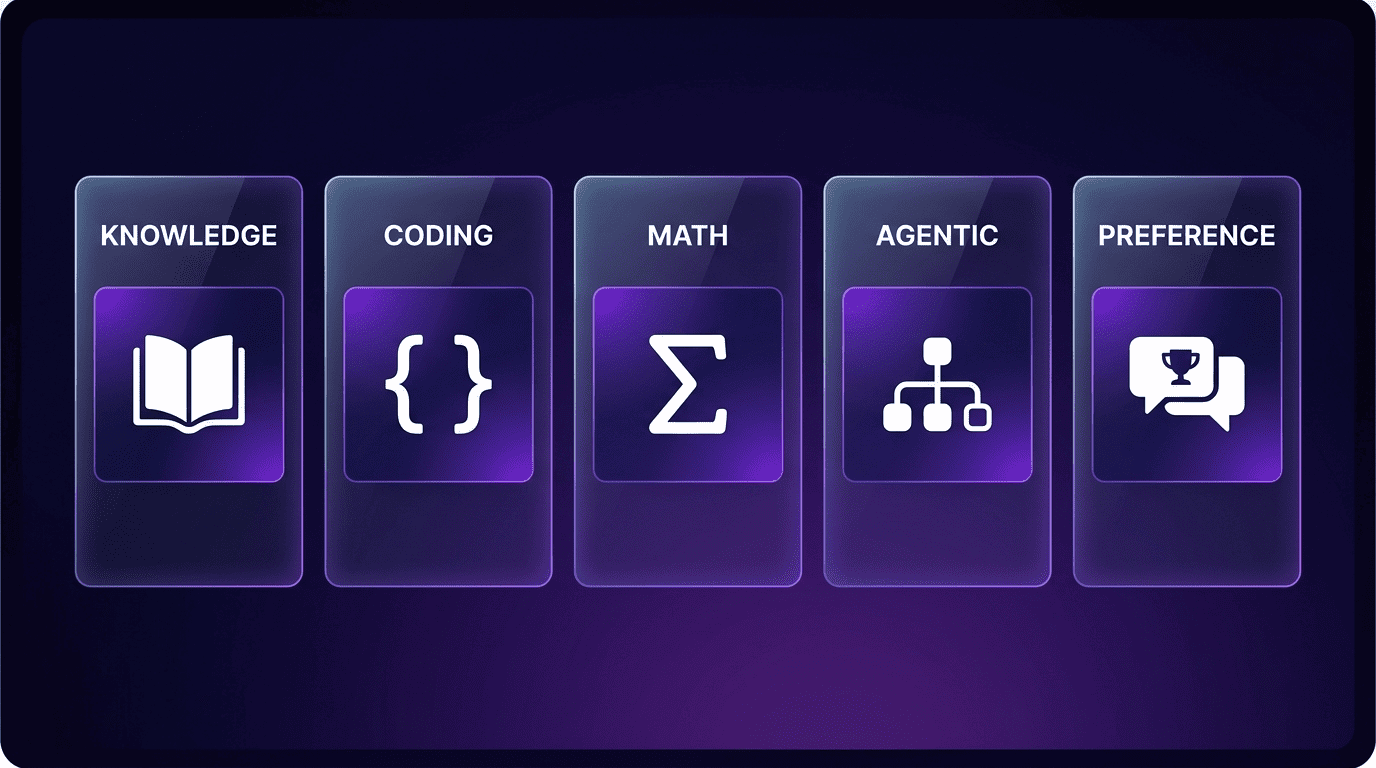
Qwen releases — spanning the Qwen3 series, Qwen2.5, and the Qwen-Coder specialists — get evaluated across five broad families: knowledge, coding, math, agentic tool use, and human preference. The table below defines each major benchmark without quoting any scores, since scores are release-specific and belong on the primary source, not in a reference guide like this one.
| Benchmark | Category | What it measures | Watch-out |
|---|---|---|---|
| MMLU / MMLU-Pro | Knowledge | Multitask multiple-choice questions across roughly 57 subjects | Original MMLU is near-saturated for frontier models; MMLU-Pro is the harder successor |
| GPQA (Diamond) | Reasoning | Graduate-level science questions designed to resist quick web lookup | Small question set, so scores carry high variance |
| HumanEval / MBPP / EvalPlus | Coding | Function-level code generation from a docstring or prompt | Classic HumanEval/MBPP sets are largely saturated and leak-prone; EvalPlus adds stricter tests |
| LiveCodeBench | Coding | Fresh competitive-programming problems collected over time | Contamination-resistant by design, since new problems keep arriving after training cutoffs |
| SWE-bench Verified | Coding (agentic) | Fixing real, verified GitHub issues inside real repositories | Results are sensitive to the evaluation harness and tool scaffolding used |
| AIME (current year) | Math | Hard competition math with integer answers | Only around 30 problems per year, so results are noisy |
| MATH / GSM8K | Math | Step-by-step math problems; GSM8K is grade-school word problems | GSM8K is considered saturated for modern large models |
| BFCL | Agentic | Function- and tool-calling accuracy | Format-sensitive — small prompt changes can shift results |
| LMArena (Chatbot Arena) | Human preference | Head-to-head human votes converted into an Elo rating | Prone to style and verbosity bias rather than pure correctness |
Knowledge and reasoning: MMLU, MMLU-Pro, GPQA
MMLU tests broad multitask knowledge — history, law, medicine, physics — through multiple-choice questions, and it was for years the default headline number for “how much does this model know.” MMLU-Pro raises the bar: it adds more answer options per question, leans harder on reasoning rather than recall, and was built specifically because plain MMLU stopped separating top models from each other. GPQA Diamond goes a step further, using expert-written graduate-level science questions that are deliberately hard to answer by pattern-matching a quick search.
That progression — MMLU losing its discriminating power, MMLU-Pro and GPQA taking over — is exactly why newer Qwen releases tend to foreground MMLU-Pro and GPQA over the original MMLU. If you see a specific figure attached to any of these three, treat it as reported by whichever source published it and verify it against that source before repeating it.
- MMLU — broad, multitask, largely saturated at the frontier.
- MMLU-Pro — harder variant with more options, reasoning-heavy.
- GPQA Diamond — small, expert-level, resists casual lookup.
Coding: HumanEval, MBPP, LiveCodeBench, SWE-bench
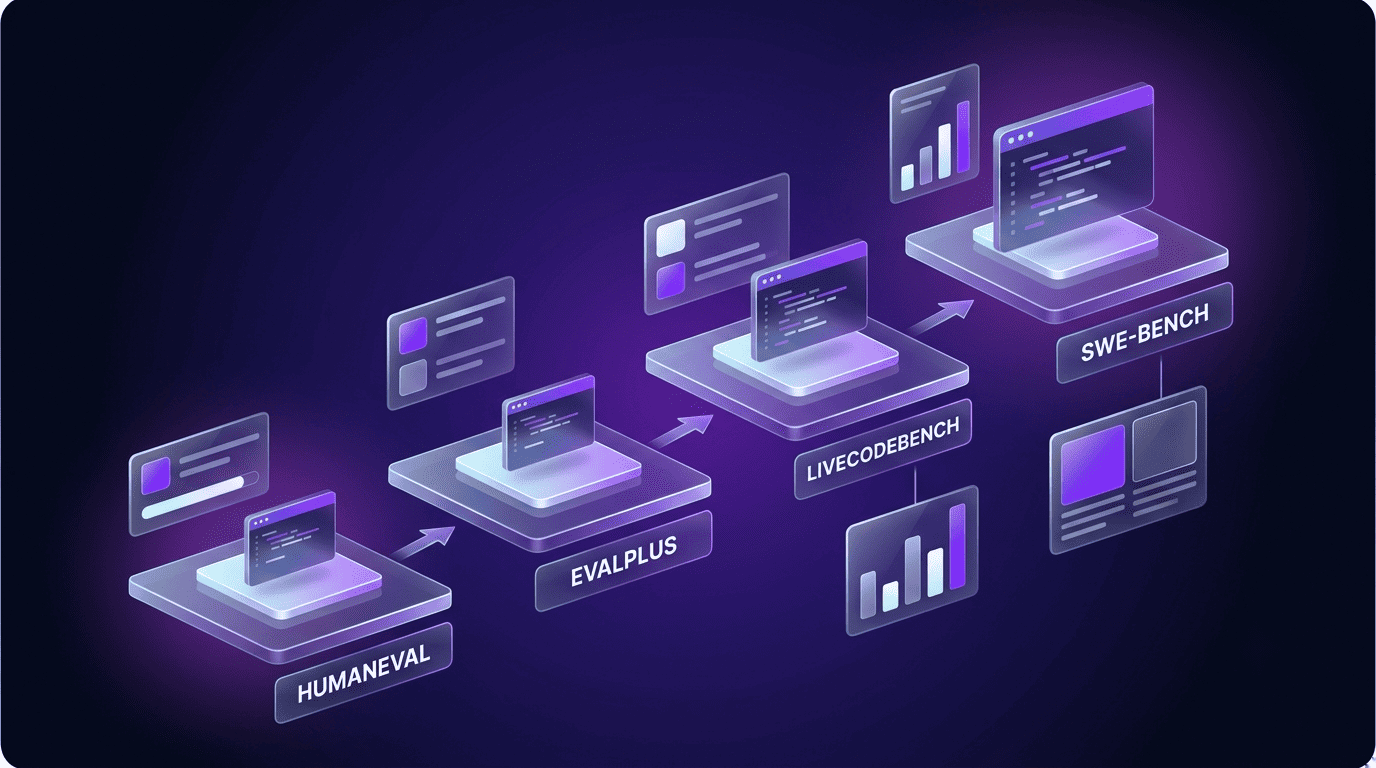
Coding evaluation for the Qwen family runs on a ladder of increasing difficulty and increasing resistance to contamination. HumanEval and MBPP sit at the bottom: single-function problems from a docstring, now considered easy and, worse, prone to appearing in training data verbatim. EvalPlus sits above them, reusing the same problem style but adding many more test cases per problem so a model can’t pass by writing code that merely looks right.
LiveCodeBench is the next rung up, built from competitive-programming problems collected on a rolling basis, which makes it contamination-resistant almost by construction — a model trained before a given month simply cannot have seen that month’s problems. SWE-bench Verified sits at the top of the ladder and moves past single functions entirely: it asks a model to fix real, human-verified issues inside real GitHub repositories, which tests agentic, multi-file reasoning rather than isolated code generation.
The Qwen2.5-Coder blog reports results across this whole range — EvalPlus, LiveCodeBench, BigCodeBench, Aider, McEval, RepoEval, and SAFIM among others — which is worth knowing before you go looking for a single “the” coding score, because the Qwen team itself reports several.
Math: AIME, MATH, GSM8K
Math evaluation for Qwen models typically spans three tiers of difficulty. GSM8K sits at the easy end: grade-school word problems that modern frontier models handle well enough that the benchmark is considered saturated and rarely separates top performers anymore. MATH sits above it, drawing on harder competition-style problems that require multi-step reasoning rather than a single arithmetic operation. AIME sits at the top — genuine American Invitational Mathematics Examination problems, the kind used to select competition finalists, with answers that are always integers.
The catch with AIME specifically is scale: there are only around 30 problems released per year, so a model getting two or three additional problems right or wrong swings the reported percentage by several points. A single AIME number from one release should be read as noisy, not precise, and comparing two models’ AIME scores from different years or different problem subsets is not a like-for-like comparison.
Agentic and tool use: BFCL and friends
Agentic and tool-use benchmarks matter for Qwen because Qwen3 markets itself on agentic ability and an explicit “thinking” mode, and both claims live or die on how well the model actually calls tools and follows multi-step plans. BFCL (the Berkeley Function-Calling Leaderboard) is the most commonly cited benchmark in this family, alongside others like tau-bench, and together they test a cluster of related skills:
- Function selection — picking the right tool out of several available ones for a given request.
- Argument filling — populating a function call’s parameters correctly and in the expected format.
- Multi-step execution — chaining several tool calls together to complete a task.
- Error recovery — noticing a failed call or bad result and adjusting the next step accordingly.
These benchmarks are notably format-sensitive: a model can score very differently depending on how the tool schema is presented, which is one more reason to treat a bare agentic score as a starting point rather than a settled fact.
Human-preference leaderboards: LMArena / Chatbot Arena
LMArena — originally launched as Chatbot Arena — takes a different approach from the static benchmarks above: real people submit a prompt, get back two anonymous model responses side by side, and vote for the one they prefer. Those pairwise votes get converted into an Elo rating, the same rating system used in chess, so the resulting leaderboard reflects aggregated human preference rather than correctness on a fixed answer key.
That makes LMArena good at capturing something the static tests miss entirely — how a response “feels,” whether it’s helpful, well-formatted, and pleasant to read — but it comes with its own biases. Voters tend to reward longer, more confidently formatted answers even when a shorter answer was just as correct, so verbosity and markdown styling can nudge a rating up independent of underlying quality.
Qwen’s open-weight models have ranked among the strongest open-weight models on human-preference leaderboards in recent release cycles, competing on the same public boards as the current proprietary flagships — OpenAI’s GPT-5.6 Sol and Anthropic’s Claude Fable 5 among them. Rather than quoting a specific rank or Elo number here, which shifts as new models enter the arena, the more reliable move is to check the live board directly at lmarena.ai whenever you need a current answer.
How Qwen models position themselves (per Alibaba’s own reports)
The Qwen lineage breaks roughly into three tracks, and understanding the split helps explain why benchmark charts differ from release to release. Qwen2.5 is the broad foundation family, spanning many parameter sizes for general use. Qwen2.5-Coder narrows that foundation into code specialists, tuned and evaluated specifically against coding benchmarks. Qwen3 is the newer generation built around a hybrid thinking/non-thinking mode, mixing Mixture-of-Experts (MoE) and dense architectures, released under the Apache 2.0 license, and covering 119 languages.
Qwen2.5, Qwen3 and Qwen-Coder in the Qwen team’s words
Here’s how the Qwen team itself frames its flagship model’s benchmark standing:
Our flagship model, Qwen3-235B-A22B, achieves competitive results in benchmark evaluations of coding, math, general capabilities, etc., when compared to other top-tier models such as DeepSeek-R1, o1, o3-mini, Grok-3, and Gemini-2.5-Pro.
Qwen team, “Qwen3: Think Deeper, Act Faster”
The coding side gets a similarly confident, self-reported claim: the Qwen team describes Qwen2.5-Coder-32B-Instruct as a “SOTA open-source code model, matching the coding capabilities of GPT-4o,” in the Qwen2.5-Coder series blog. Both of these are vendor claims made by the model’s own creators, which doesn’t make them false, but does mean they were measured under conditions the Qwen team chose and reported. For a neutral overview of the family’s release history and licensing, the Qwen Wikipedia entry is a useful starting point that isn’t written by the vendor.
Thinking vs non-thinking mode changes the number
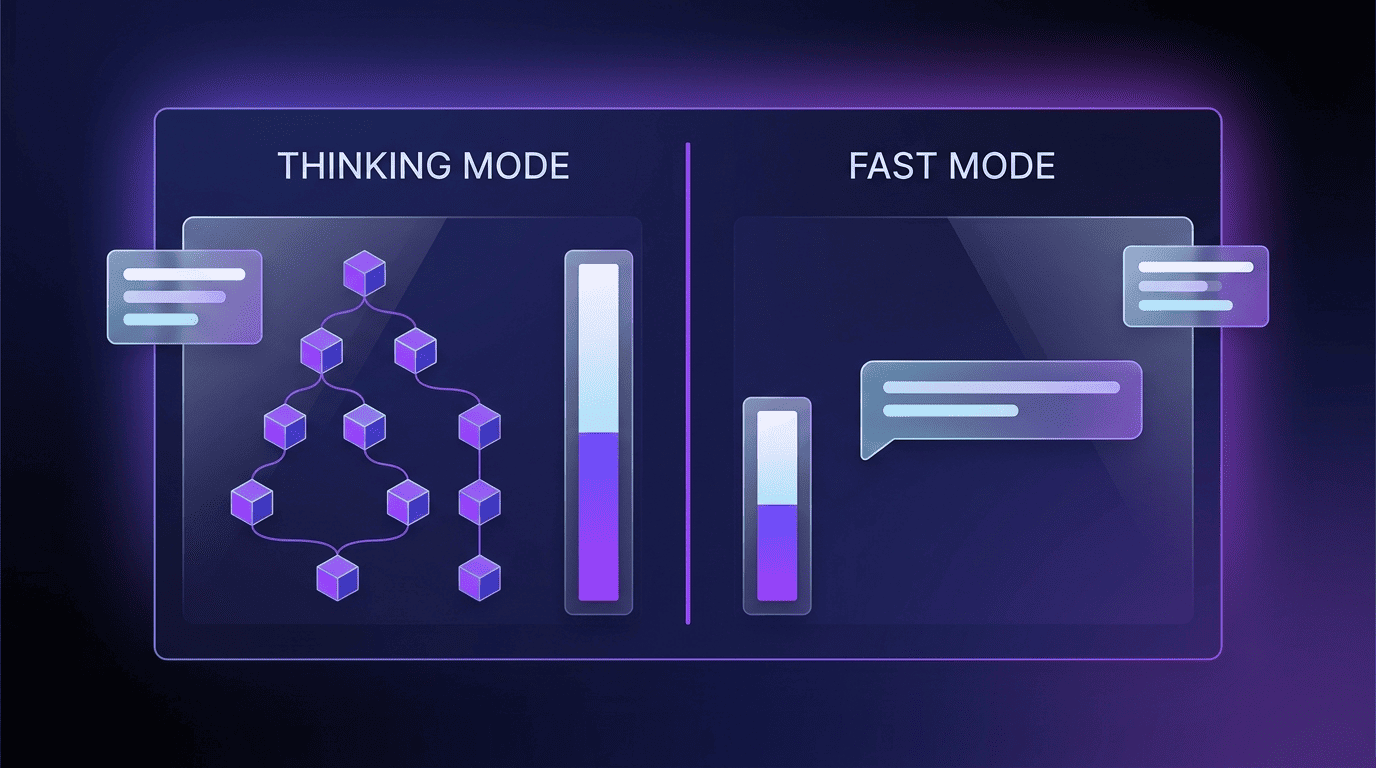
One detail trips up a lot of readers comparing Qwen3 numbers across sources: Qwen3 supports both a “thinking” mode, where it reasons at length before answering, and a non-thinking mode for faster replies. Thinking mode usually posts noticeably higher reasoning and math scores than non-thinking mode on the same model, at the cost of more tokens and higher latency per answer. Before comparing two quoted scores, check which mode produced each one — and apply the same scrutiny to base-model versus instruct-tuned checkpoints, since those also produce different numbers on the same benchmark.
How to read any Qwen benchmark cautiously
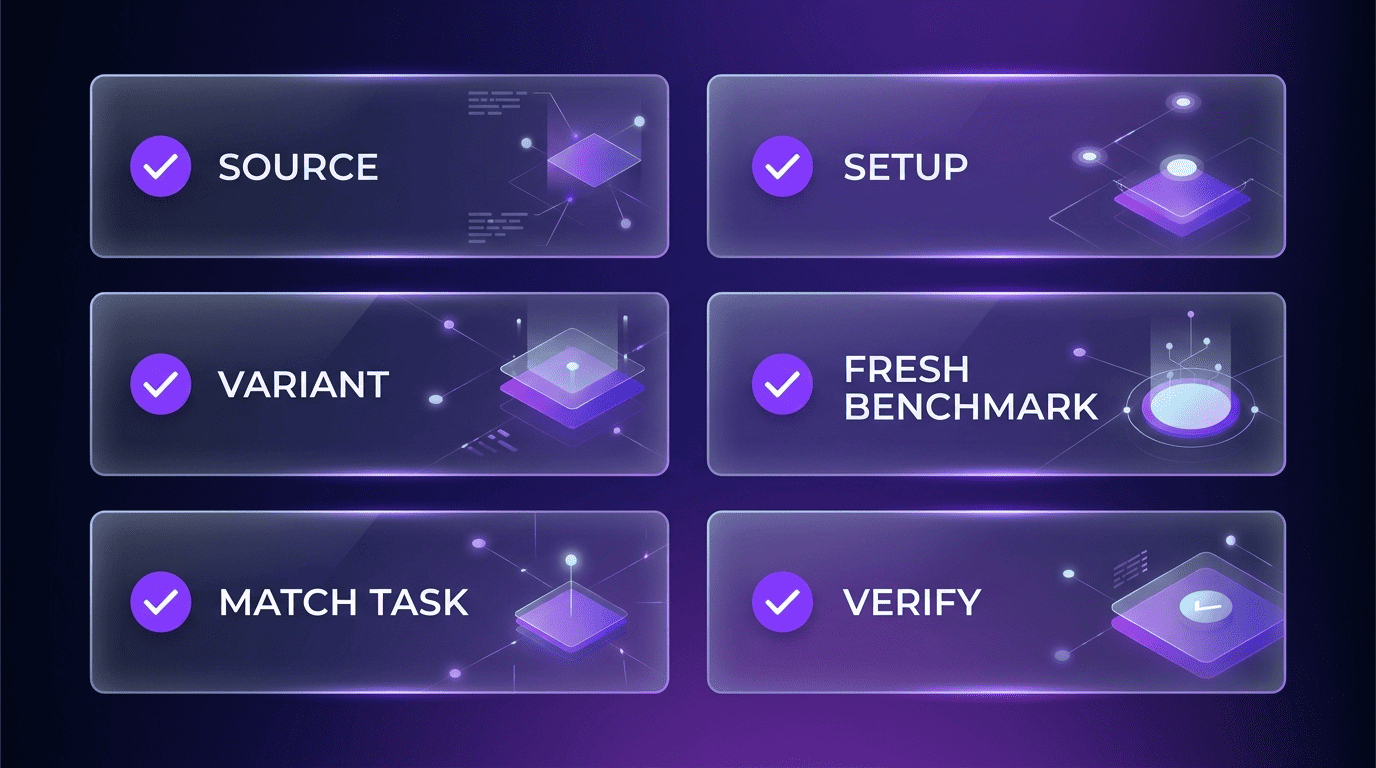
Treat every benchmark figure you encounter — on this site, on the official Qwen blog, or anywhere else — as a claim to verify, not a fact to repeat. This short checklist covers what to check before quoting a number:
- Check the source — is it the official Qwen blog or model card, the technical report, or an independent third party?
- Check the setup — thinking vs non-thinking mode, few-shot count, pass@1 vs pass@k.
- Check the model variant and size — base vs instruct, and for MoE models, active parameters vs total parameters.
- Prefer contamination-resistant benchmarks (LiveCodeBench) and live arenas (LMArena) over older, saturated tests.
- Match the benchmark to your actual task — a coding score tells you nothing about writing quality, and vice versa.
- Never compare numbers across different setups, model versions, or release dates as if they were equivalent.
- Verify the exact figure on the primary source before quoting it anywhere else.
Once you know what to check, the next question is simply where to look. The table below is a quick map to the primary sources for Qwen benchmark data — no scores, just where to find them.
| Source | What you’ll find | Link |
|---|---|---|
| Qwen blog | Per-release benchmark charts and positioning claims from the Qwen team | qwenlm.github.io |
| Hugging Face model cards | Per-model results, configs, and download links | huggingface.co/Qwen |
| GitHub | READMEs, evaluation code, and release notes | github.com/QwenLM |
| LMArena (Chatbot Arena) | Live, independent human-preference ranking | lmarena.ai |